
Charlotte County Sex Offender Registry
Charlotte County sex offenders register with the Charlotte County Sheriff's Office in Punta Gorda. The sheriff processes all registrations for the county and sends data to FDLE within 24 hours of any change. This page explains registration requirements in Charlotte County, the two categories of registered persons under Florida law, and how to search the public FDLE database for registered offenders and predators in this Southwest Florida county.
Charlotte County Sheriff and Sex Offender Registration
The Charlotte County Sheriff's Office handles all sex offender registration for Charlotte County, including the city of Punta Gorda and all unincorporated areas. Registration does not go through Punta Gorda city police or any other municipal agency. If you live, work, or regularly spend time in Charlotte County and have a qualifying sex offense conviction, you register with the Charlotte County Sheriff's Office. Period.
Charlotte County sits on Florida's southwest Gulf Coast between Sarasota and Lee counties. The county has a significant retiree population and a mix of urban and rural settings. The sheriff's office covers the full geographic area, including Port Charlotte, Englewood, Punta Gorda, and all unincorporated communities. Registration is handled at the main facility in Punta Gorda, where staff collect photographs, fingerprints, and all required identifying information.
| Office | Charlotte County Sheriff's Office |
|---|---|
| Address | 7474 Utilities Rd, Punta Gorda, FL 33982 |
| Phone | (941) 639-2101 |
| Hours | Call to confirm current registration hours |
| Website | www.charlottecountyfl.gov/sheriff |
When registering at the Charlotte County Sheriff's Office, bring valid photo identification and any court documents related to your conviction. Staff use those documents to place you in the correct registration category under Florida law, which determines your reporting schedule. Out-of-state registrants should bring all available conviction records from the prior state. Once processed, registration data goes to FDLE within 24 hours, making it immediately searchable in the public database.
Registration Requirements in Charlotte County
Florida's registration rules come from Florida Statute § 943.0435. The statute applies uniformly in Charlotte County and every other Florida county. Sexual offenders report to the Charlotte County Sheriff's Office twice per year. Sexual predators report four times per year. Both categories must report within 48 hours of any change to their registered information.
The change-reporting rule catches people off guard more than anything else in the statute. A lot of things count as changes: a new home address, a new apartment, a new vehicle, a new job, a new school, a new phone number, a new email address, a new social media profile. Each of those changes triggers a two-day window to appear in person at the Charlotte County Sheriff's Office and update the record. There is no option to wait for the next scheduled check-in visit. Two days is the deadline.
Transient offenders, those who lack a fixed address, must report every 30 days. Charlotte County includes waterfront communities and areas that attract seasonal visitors, some of whom may be registered offenders without stable housing. The 30-day rule applies to anyone in transient status regardless of why they lack a permanent address. The sheriff's office enforces this without exception.
New arrivals to Florida have 48 hours from the moment they establish any residence in the state to report and register. The clock starts on arrival, not when a permanent home is found. Someone who moves into a Charlotte County short-term rental after relocating from another state must register within two days of moving in, even if they plan to find permanent housing shortly. Bring court documents from the prior state when registering for the first time in Florida.
Sexual Predators and Sexual Offenders in Charlotte County
Florida's sex offender registry includes two distinct types of registrants: sexual offenders and sexual predators. Both are public. Both must register in Charlotte County. But the rules they face, and the way the community is notified about them, differ significantly.
A sexual predator designation is a court-issued label governed by Florida Statute § 775.21, the Florida Sexual Predators Act. At sentencing, a judge designates an individual as a sexual predator based on the offense, any prior history, and statutory criteria. The Department of Corrections notifies FDLE of the designation, and it appears permanently on the person's public registry profile. Predator status follows the individual regardless of where in Florida they move.
In Charlotte County, a sexual predator must report to the sheriff's office four times per year. Standard sexual offenders report twice. When a predator registers or relocates to a new address in Charlotte County, FDLE is required to notify local law enforcement agencies about the new location. Active community notification may follow, particularly for predators who move into established residential areas. The Charlotte County Sheriff's Office coordinates those notifications.
Sexual offenders, the broader category, include everyone with a qualifying sex conviction who has not been formally designated a predator. They still appear in the public database, still face the twice-yearly reporting schedule, and are still subject to all 48-hour change-reporting requirements. The practical differences lie in reporting frequency and the degree of community notification. Both categories are subject to the same residency restrictions under state law.
How to Search Charlotte County Sex Offenders
The FDLE sex offender database is the official and most current source for Charlotte County registry searches. It is free, requires no login, and covers all 67 Florida counties. To narrow results to Charlotte County, select Charlotte from the county filter on the search page. Results include each registrant's name, photograph, current registered address, and offense information.
You can also search by specific address or ZIP code to find who is registered near any location in Charlotte County. The FDLE map view lets you see the geographic distribution of registrations across the county, which is useful for checking a specific neighborhood rather than looking up a known individual. The search also supports name-based queries if you know who you are looking for.
Charlotte County has a moderately sized registered population given its total county population of around 200,000. Searching by ZIP code or city name (Port Charlotte, Englewood, Rotonda West) can help narrow results to a specific area within the county. Data in the FDLE database updates within 24 hours of any registration change processed at the local level. For urgent questions, call the Charlotte County Sheriff's Office at (941) 639-2101.
Residency Restrictions in Charlotte County
Florida Statute § 775.215 sets a 1,000-foot buffer zone around schools, day care centers, parks, playgrounds, and other locations where children regularly gather. No registered sex offender or predator may live within that zone. The measurement runs from the property line of the restricted location to the registrant's residence.
Charlotte County includes a mix of densely developed coastal communities and more rural inland areas. In places like Port Charlotte, which has a suburban layout with many schools and parks, the 1,000-foot restriction can limit housing options significantly. An offender or predator looking for housing in those areas should map out all restricted zones before signing a lease. What looks like a compliant address on the surface may fall within a restricted zone once the full perimeter of a nearby school or park is measured.
Punta Gorda and other incorporated cities within Charlotte County may adopt local ordinances that go beyond the state baseline. A city can extend the buffer zone to 1,500 or 2,500 feet, or restrict additional types of locations. Anyone planning to live within city limits should check with the relevant city government as well as the Charlotte County Sheriff's Office before selecting a home. The state restriction and any local ordinance both apply, and the stricter rule controls.
FDLE Registry Homepage
The Florida Department of Law Enforcement hosts the official statewide sex offender registry that covers Charlotte County and all of Florida.
All Charlotte County registrations processed by the sheriff's office flow into this database within 24 hours. The FDLE site is the authoritative public source for sex offender data in Charlotte County and the most reliable tool for checking current registry status.
FDLE Offender Search
The FDLE search tool supports county filtering, geographic search, and name lookup for all of Florida.
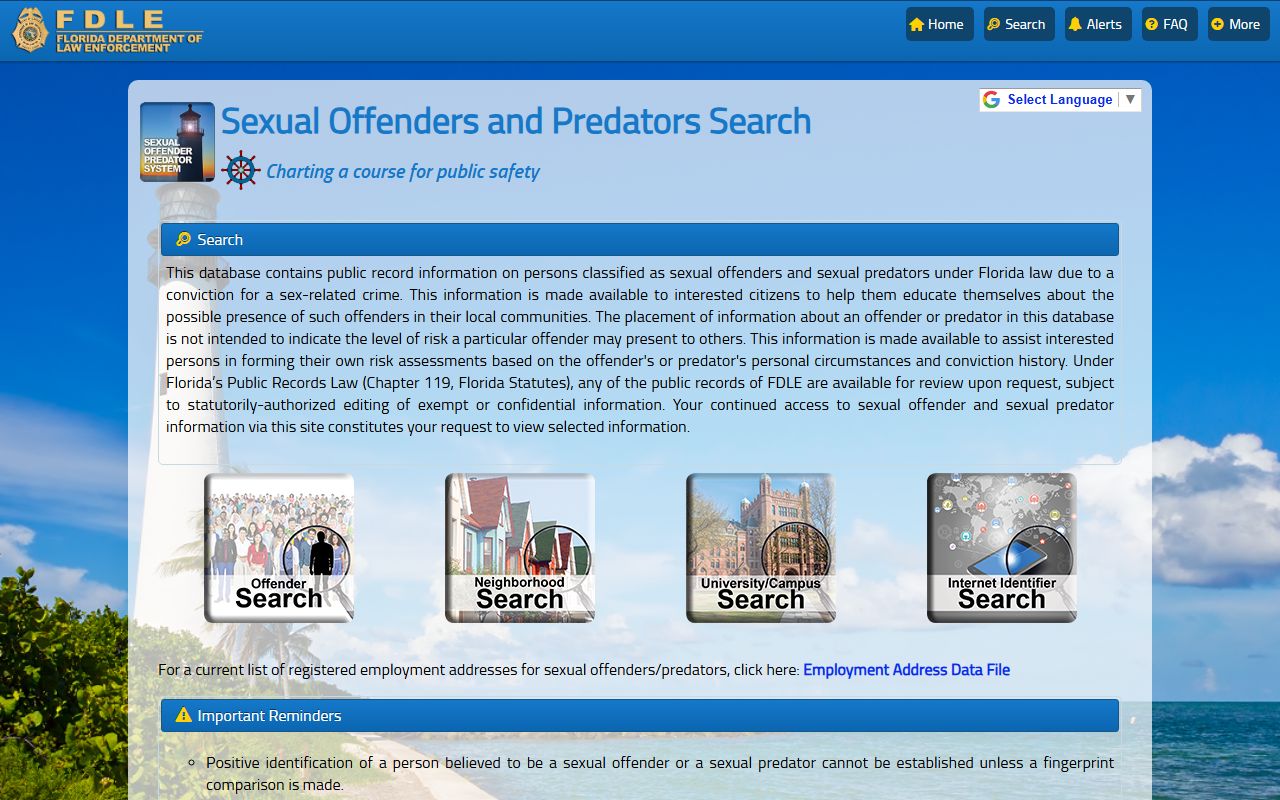
Select Charlotte County in the FDLE offender search tool to view all current registrations in the county. Search by name, address, or ZIP code, or use the map view to browse results geographically. Each result includes a photograph, current registered address, and offense details.
Florida Offender Alert Notifications
The Florida Offender Alert system lets you receive free email notifications when a sex offender or predator registers near any address you specify. It covers all of Florida, including Charlotte County. Sign up through the Florida Offender Alert website.
To use the service, enter one or more addresses you want to monitor and set your preferred notification radius. The system will send an email alert when a new registration falls within that distance of your chosen address. It also alerts you when an existing registrant moves to an address within your radius. You can monitor your home, your child's school, or any other location you care about.
This service is useful for Charlotte County families who want ongoing awareness of registration changes in their area without relying on manual searches. The alert system draws from the same FDLE data as the public search tool, so information is consistent. Alerts typically go out within hours of a registry update, which gives you a timely heads-up when something changes near you.
Cities in Charlotte County
No cities in Charlotte County meet the population threshold for a dedicated page on this site. Port Charlotte is the largest community in the county, though it is an unincorporated area rather than an incorporated city. Punta Gorda is the county seat and the primary incorporated city. Sex offender registration for all Charlotte County residents is handled through the Charlotte County Sheriff's Office at 7474 Utilities Rd, Punta Gorda, FL 33982.
Nearby Counties
Charlotte County shares borders with these Southwest Florida counties. Each county maintains its own registration process through the local sheriff's office.