
Florida Sex Offender Registry
Florida's sex offender registry is run by the Florida Department of Law Enforcement (FDLE) and is open to the public at no cost. You can search by name, address, city, county, or zip code through the FDLE portal any time of day or night. The registry lists both sexual offenders and sexual predators who are required by state law to register with their county sheriff's office. This page explains how the registry works, who must register, what the law says, and how to find offenders near you.
Florida Sex Offender Quick Facts
About the Florida Sex Offender Registry
The Florida sex offender registry is one of the most detailed public databases in the country. FDLE maintains the registry and updates it on a continuous basis as new information comes in from county sheriff offices and other law enforcement agencies. Each record in the database can include a photo, physical description, home address, work address, vehicle details, and the nature of the offense that triggered registration. Anyone can access it for free.
Florida law creates two separate categories of registrants. A sexual offender is a person convicted of certain sex crimes who must register under Florida Statute 943.0435. A sexual predator is a person who receives that designation through a formal court finding, governed by Florida Statute 775.21. Sexual predators face stricter rules, including more frequent registration and active community notification. Both types appear on the public registry.
The registry covers people who live in Florida, work in the state, or attend school here. Out-of-state residents who are in Florida for more than three days must register. That rule also applies to people who travel to Florida for work or academic study, even if they have a home address in another state.
The FDLE offender search site is the official starting point for any search. It links to the main search portal, a FAQ page, relevant Florida statutes, and other national registries. The site is maintained by the Florida Department of Law Enforcement, which is the state-level agency responsible for managing all sex offender data statewide.
Visit the FDLE Florida Sex Offenders homepage to start a search or review registry information.
The FDLE homepage provides direct links to the search portal, FAQ, and Florida statutes related to sex offender registration.
How to Search Florida Sex Offenders
The FDLE search portal lets you look up Florida sex offenders several ways. You can search by full name or partial name. You can also search by area using a city, county, or zip code. There is an option to search near a specific street address, which is useful if you want to know who is registered within a set distance of your home, a school, or another location. The results show a list of matching registrants with photos and key details.
Each search result links to a full profile page for that registrant. The profile shows the person's name, aliases, date of birth, physical description, tattoos, scars, current address, employer, vehicle information, and the qualifying offense. It also shows whether the person is a sexual offender or a sexual predator, since the two categories carry different legal requirements. Predator profiles include a note that the person has been formally designated under Florida law.
The database is updated regularly. That said, there can be a short lag between when a person registers or updates their information at the sheriff's office and when that change appears online. If you need the most current information on a specific person, you can call the FDLE hotline at 1-888-357-7332 (1-888-FL-PREDATOR), available Monday through Friday, 8 a.m. to 5 p.m. Eastern time. You can also email sexpred@fdle.state.fl.us with questions.
Access the FDLE sex offender search portal directly to run a search by name or location.
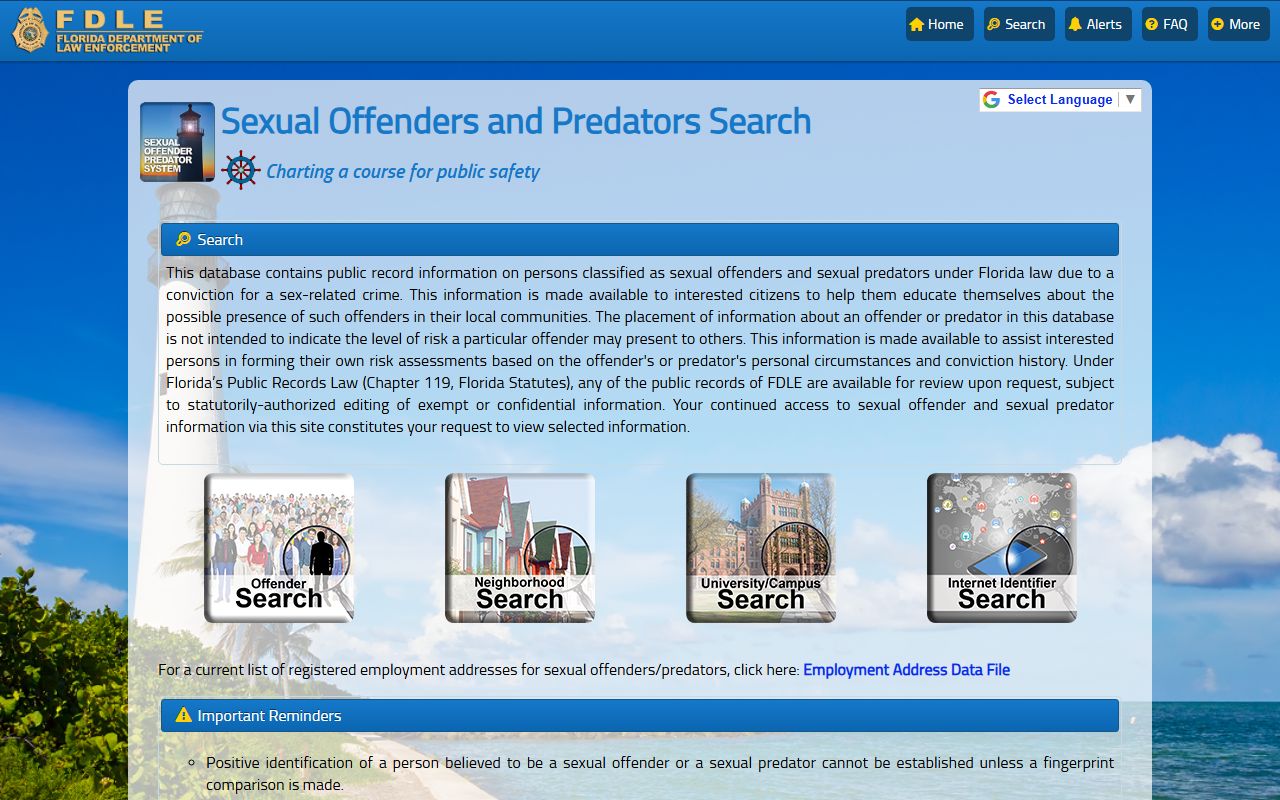
The FDLE search portal supports name, area, and proximity searches against the full statewide Florida sex offender database.
Registration Requirements in Florida
Florida has strict rules about when and how sex offenders must register. The main registration statute is 943.0435, which sets out the full list of information that must be provided and the deadlines for doing so. Initial registration must happen within 48 hours of establishing a residence, being released from custody, or moving to Florida from another state.
Registration takes place in person at the county sheriff's office where the person lives. At the time of registration, the person must provide their full legal name and any aliases, date of birth, Social Security number, race, sex, height, weight, tattoo and scar descriptions, fingerprints, palm prints, and a photo. They must also give the address of their home, place of work, and any school they attend, as well as details about any vehicles they own or drive. Phone numbers, email addresses, and all internet identifiers must be reported before the person begins using them, not after.
Sexual offenders must return to the sheriff's office to re-register twice a year: once during their birth month and once six months after that. Sexual predators must re-register four times a year, once every 90 days. People who are transient and have no fixed address must check in every 30 days. When a person plans to move out of state, they must give 48 hours' advance notice. International travel requires 21 days' advance notice to the sheriff.
Failure to register on time is a third-degree felony under Florida law, punishable by up to five years in prison. Giving false information at registration is also a third-degree felony. Failing to report that you have vacated a residence is a second-degree felony, which carries a maximum sentence of 15 years. The Florida legislature has made clear that these rules carry real consequences.
Florida Sex Offender Laws
Two statutes form the core of Florida's sex offender framework. Section 943.0435 covers registration requirements for sexual offenders. It defines who must register, what information they must provide, how often they must re-register, and what penalties apply for noncompliance. Section 775.21 covers the sexual predator designation, which is a more serious classification triggered by a formal court finding. Predators face quarterly re-registration and active public notification requirements that go beyond what standard offenders face.
Residency restrictions under Florida Statute 775.215 bar registered sex offenders from living within 1,000 feet of a school, day care center, park, or playground. This rule affects where offenders can rent or buy a home and has pushed many registrants into areas where qualifying housing is scarce. Law enforcement tracks compliance with these restrictions as part of routine supervision.
The Dangerous Sexual Felony Offender Act, found in Florida Statute 794.0115, sets mandatory minimum sentences for repeat or violent sex offenses. Depending on the nature of the offense and the offender's history, those minimums can reach 25 or 50 years. The Jimmy Ryce Involuntary Civil Commitment Act allows the state to seek civil commitment for sexually violent predators who are about to be released from prison, keeping them in a secure treatment facility if a judge finds they pose a continuing danger.
Florida does have a limited exception sometimes called the Romeo and Juliet Law. It allows certain young offenders, where the victim and the offender were close in age and the relationship was consensual, to petition the court for removal from the registry. Not every case qualifies. The court reviews each petition individually based on the specific facts of the offense.
Probation conditions for sex offenders in Florida are set out in Florida Statute 948.30. Those conditions typically include mandatory sex offender treatment, curfew restrictions, and limits on contact with minors. Supervised probation can last for years or for the remainder of a person's life, depending on the offense and sentence imposed.
View the full list of Florida statutes related to sex offender registration on the FDLE legal reference page.
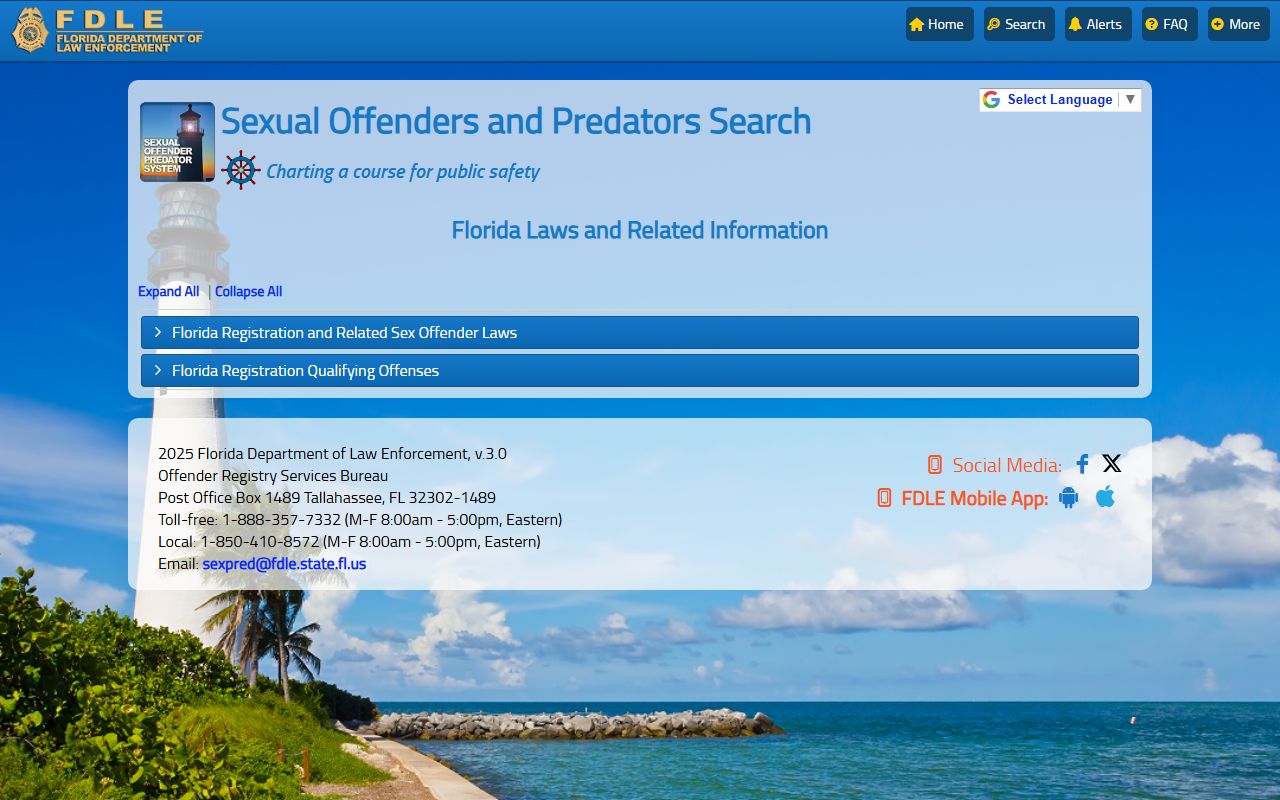
The FDLE statutes page provides links to each Florida law that governs sex offender registration, predator designation, and related penalties.
Frequently Asked Questions
The FDLE FAQ page answers many of the most common questions about the Florida sex offender registry. It covers how to search, what the different categories mean, and what offenders are required to do. Below are some of the key questions and answers drawn from that resource.
Who must register in Florida? Any person convicted of a qualifying sex offense in Florida must register. People convicted in other states, federal courts, or foreign countries must also register if they live, work, or go to school in Florida. The list of qualifying offenses is set by statute and includes a wide range of crimes against adults and children.
Can I get email alerts when a sex offender moves near me? Yes. Florida runs an alert service at floridaoffenderalert.com that sends notifications when a registered sex offender or predator moves into a zip code you have signed up to watch. The service is free and is operated in connection with FDLE.
What is the difference between a sex offender and a sex predator? A sexual offender is anyone required to register under the registration statute. A sexual predator is a person who a court has formally designated as such, typically after conviction for the most serious offenses or for repeat offenses. Predators face more frequent registration, more active public notification, and stricter supervision conditions.
What information does the registry include? Each registry profile can include a current photo, physical description, home and work addresses, vehicle information, internet identifiers, and details about the qualifying offense. The amount of information shown can vary based on what the registrant has reported and what law enforcement has verified.
How current is the database? FDLE updates the registry on a continuous basis as new data arrives from county sheriffs and other agencies. The site is available 24 hours a day, seven days a week. For time-sensitive questions, call 1-888-357-7332 during business hours or contact the local sheriff's office directly.
Read the full FDLE FAQ page for additional questions and answers about the Florida sex offender registry.
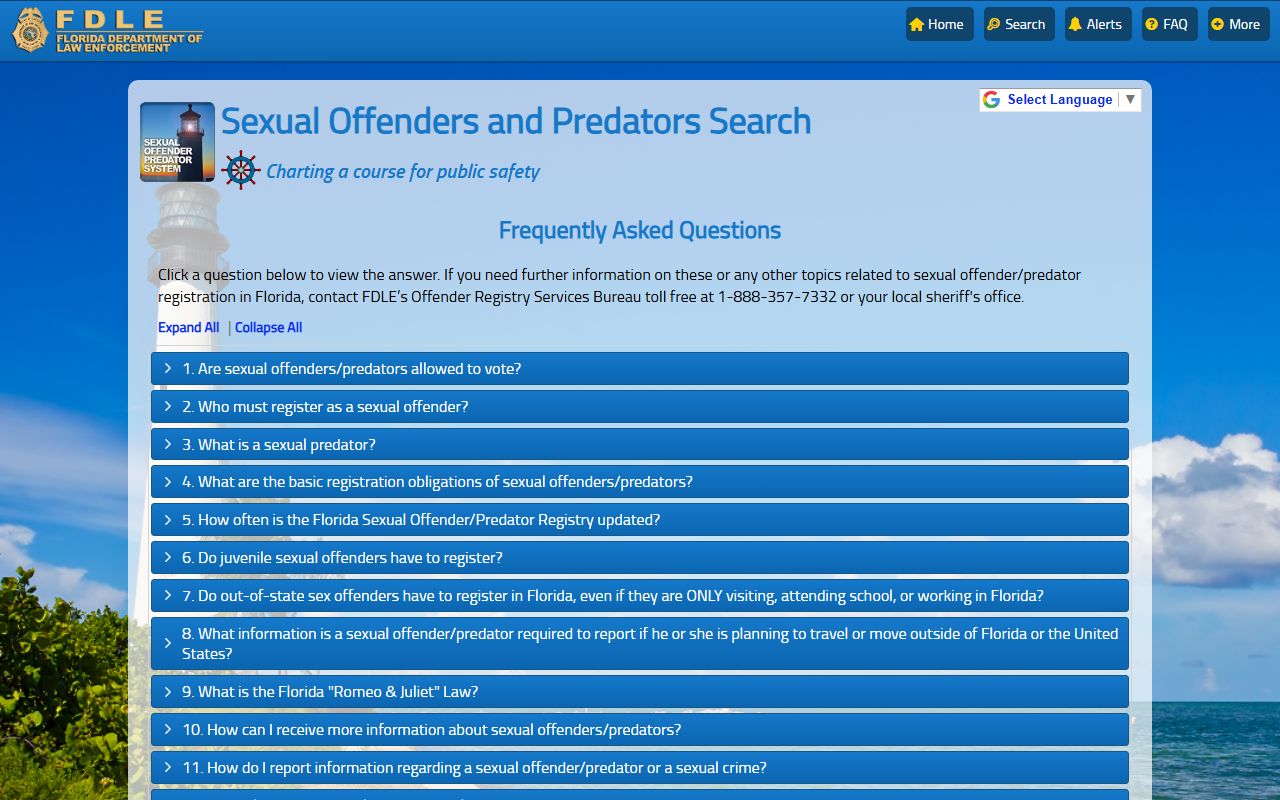
The FDLE FAQ page covers search methods, registration categories, re-registration schedules, and public notification rules for the Florida registry.
Other Resources for Florida Sex Offender Information
Beyond the main FDLE search portal, several other official sources can help you find sex offender information. The National Sex Offender Public Website at nsopw.gov is a federal database that links to every state registry in the country. If you need to search multiple states at once, or check whether someone is registered in another state, that is the right place to start. It is free and run by the U.S. Department of Justice.
The Florida Offender Alert system at floridaoffenderalert.com lets you sign up for email or text notifications tied to specific zip codes. When a registered sex offender or predator moves into or out of a zip code you are watching, you receive an alert. This is especially useful for parents and community organizations that want ongoing awareness rather than having to check the registry manually.
The Florida Department of Corrections at fdc.state.fl.us oversees people on probation or parole after a sex offense conviction. If someone has recently been released from state prison and is now on supervision, the DOC has records about their supervision status and conditions. The DOC also operates a public offender search tool that shows current and past inmates.
The Florida Department of Juvenile Justice at djj.state.fl.us handles cases involving juvenile offenders. In most cases, juvenile sex offense records are not public in the same way adult records are, but the DJJ can provide guidance on what information is available and what the law allows.
View the FDLE resource links page for a full list of other state and national sex offender registries.
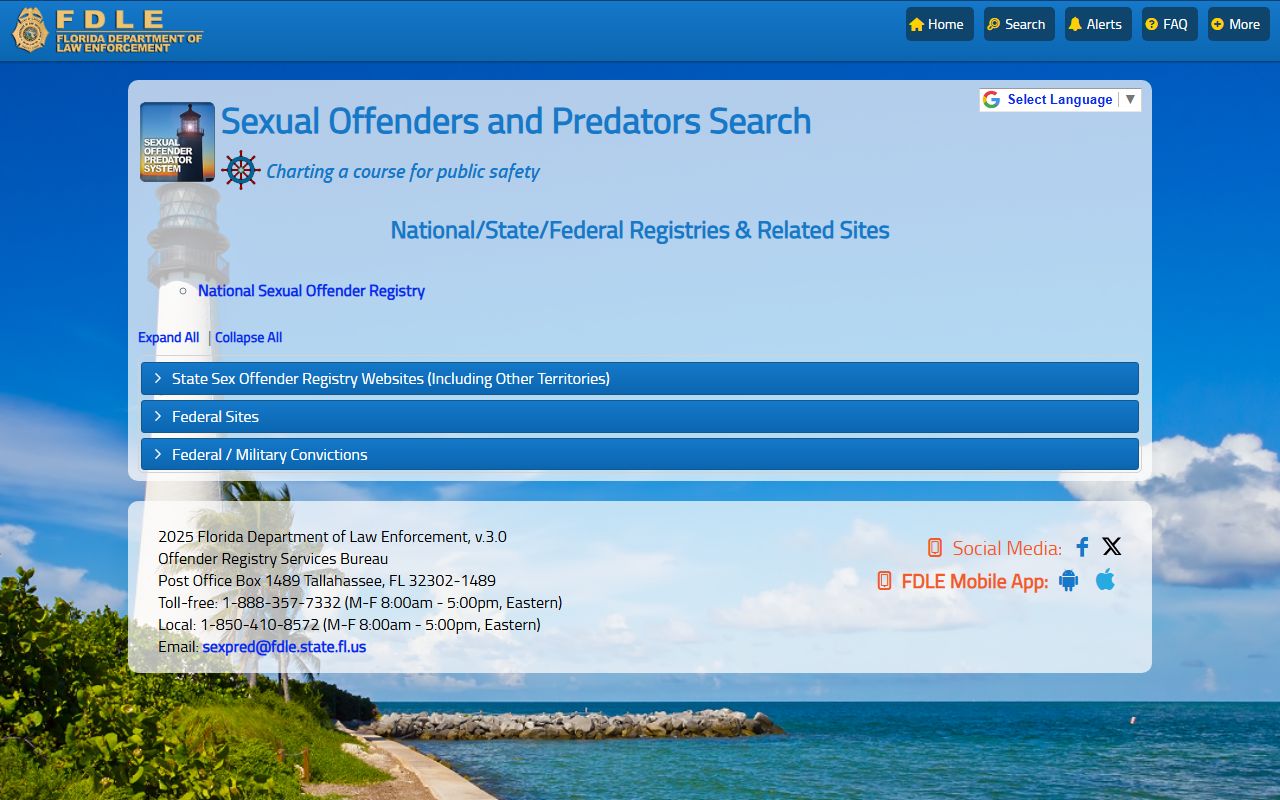
The FDLE resource links page connects to national databases, other state registries, and Florida-specific tools for sex offender information.
Using the FDLE Agency Resources
The broader FDLE agency site at fdle.state.fl.us offers more than just the sex offender registry. It houses criminal history records, missing persons databases, and a range of public safety information. If you need background on the agency itself, its mission, or the range of services it provides, that is the right place to look. The FDLE also has regional offices across Florida that work with local law enforcement on compliance and enforcement matters related to sex offender registration.
For questions that go beyond what the online tools can answer, the FDLE contact information is as follows. Phone: 1-888-357-7332 (1-888-FL-PREDATOR). Email: sexpred@fdle.state.fl.us. Hours are Monday through Friday, 8 a.m. to 5 p.m. Eastern. You can also reach the FDLE by contacting the main agency through its website. County sheriff offices are also a direct contact point for registration-related questions, since all in-person registration takes place at the sheriff's level.
Access all FDLE Florida sex offender resources through the main registry portal.
The FDLE resource page provides access to the full range of tools, contacts, and reference materials related to Florida sex offender registration and public safety.
Browse by Location
Florida Counties
Every one of Florida's 67 counties has sex offenders registered through the local sheriff's office. Browse by county to find resources, sheriff office contact information, and local registry details for any area in the state.
Florida Cities
Search Florida sex offender records by city. The pages below cover Florida's largest cities and link to county-level registration resources for each area.
View Major Florida Cities