
Find Sex Offenders in Lee County
Lee County sex offender records are maintained by the Lee County Sheriff's Office and published through Florida's statewide registry. Use the search below to look up registered sex offenders and predators anywhere in Lee County.
Lee County Sheriff's Office
The Lee County Sheriff's Office (LCSO) is the primary agency responsible for sex offender registration and tracking in Lee County. LCSO serves a county that has grown fast over the past two decades and now ranks among the larger counties in Florida by population. Cape Coral, Lehigh Acres, Fort Myers, North Fort Myers, Bonita Springs, and Estero all fall within LCSO's jurisdiction, giving the agency a broad geographic and demographic range to cover.
LCSO maintains a public-facing sex offender search tool on its website. Residents can look up offenders by name or browse listings for specific communities. The sheriff's site also tracks sex predator relocations in near real time, publishing notification dates alongside new addresses whenever a predator moves within the county. This level of transparency is part of Florida's broader commitment to open public access to registry information.
The LCSO website serves as the local hub for sex offender information in Lee County, covering everything from initial registration guidance to active relocation tracking.
Residents can bookmark the LCSO site for quick access to updated sex offender and predator listings across all parts of Lee County.
Where to Register in Lee County
Offenders must register in person with the Lee County Sheriff's Office. There is no mail-in or online option for initial or periodic registration. Bring valid photo ID and court documents on the first visit.
| Agency | Lee County Sheriff's Office (LCSO) |
|---|---|
| Phone | (239) 477-1000 |
| Website | www.sheriffleefl.org |
| Relocation Tracker | sheriffleefl.org/recent-relocations/ |
Call the LCSO ahead of your visit to confirm the current registration location and any hours of operation for the registration function. Staffing and intake procedures can change, and it is better to verify than to make a wasted trip. When you arrive, plan for the intake process to take time. The sheriff's staff will photograph you, collect fingerprints and palm prints, and document your current address, vehicle, and online accounts.
Registration Requirements in Lee County
Florida's sex offender registration law, Florida Statute § 943.0435, sets the core requirements for all counties, including Lee. Anyone convicted of a qualifying sexual offense must report in person to the sheriff's office in the county where they live within 48 hours of conviction or release from custody. If you move to Lee County from another Florida county or from another state, the 48-hour clock starts when you establish any form of residence here, even a temporary or transient one.
The statute covers a wide range of living situations. You do not need to have a lease or own property to be considered a resident. Staying in a motel, living with family, or even being homeless and staying in one area can all trigger the registration requirement. The term "transient" in the law is intentional. Florida wants to know where registered individuals are, regardless of how stable their housing is.
After the initial registration, the schedule depends on your classification. Sexual predators must check in with LCSO four times per year. Other registered sex offenders must report two or four times per year depending on the offense. At each visit, registrants confirm or update their personal information. Any change in address, phone number, vehicle, or online identifier must be reported within 48 hours of the change, not at the next scheduled visit. Waiting is not allowed.
Sex Predator Relocation Notifications
One of the more distinctive features of the LCSO sex offender program is the public relocation tracker. When a sexual predator moves to a new address within Lee County, LCSO publishes that information on its website along with the date the notification was made. This applies to moves within Fort Myers, Cape Coral, Lehigh Acres, North Fort Myers, Bonita Springs, and Estero, among other communities.
The LCSO relocation page shows entries in a straightforward format. Each listing includes the offender's name, date of birth, new address, and the notification date. For example, entries from early 2026 show moves into specific addresses in Fort Myers with notification dates noted alongside. This data is refreshed as new relocations are processed by the sheriff's office, so the page reflects recent moves rather than just historical data.
The LCSO relocation tracker gives residents a fast way to see if a predator has recently moved into their neighborhood, without having to run a full database search each time.
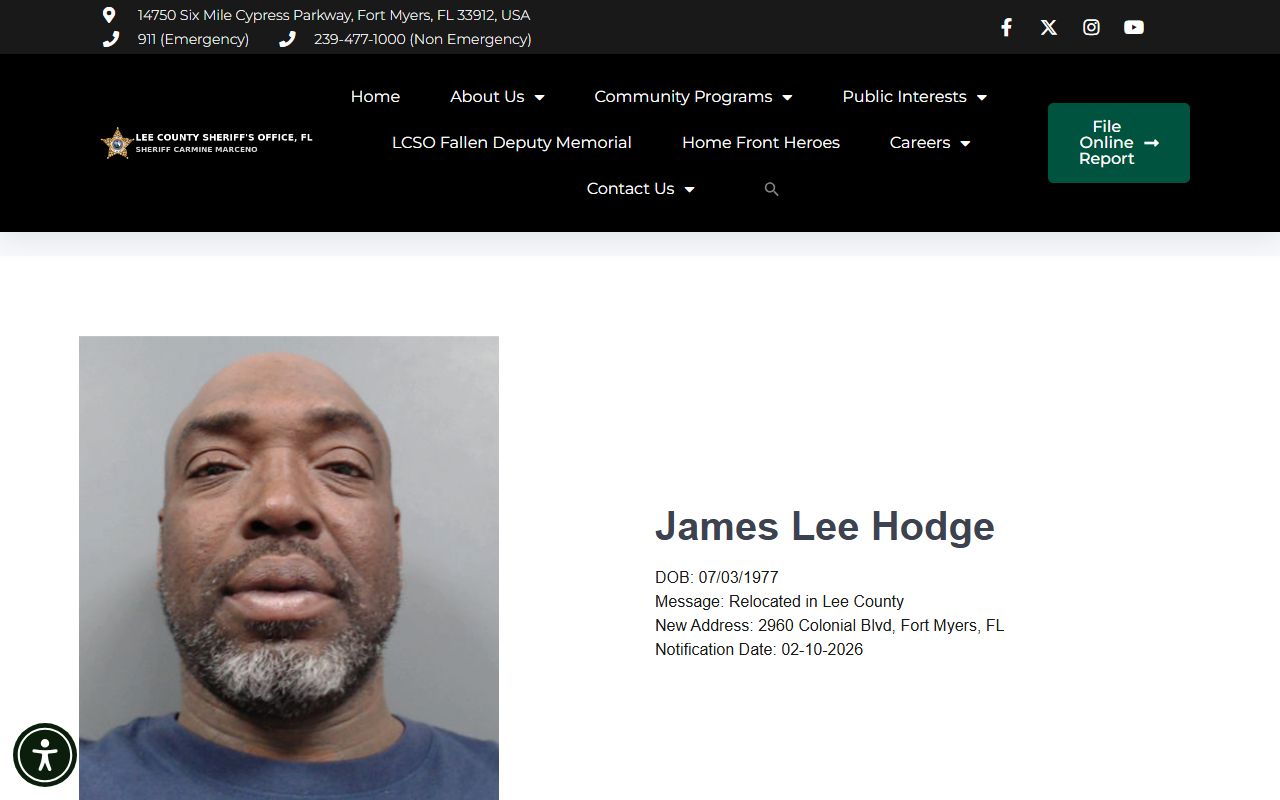
Bookmark the LCSO recent relocations page to stay current on predator moves across Lee County communities.
Searching Lee County Sex Offenders
The LCSO website has a built-in sex offender search feature. This local tool is a good first stop when you want to find offenders in a specific part of Lee County. It pulls current registration data and can be filtered by area. For a statewide view that includes all 67 Florida counties, the FDLE sex offender search is the most complete option. It covers every registered sex offender and predator in Florida and is updated on an ongoing basis.
Search results from the FDLE database include a photo, physical description, address, offense history, and vehicle information. You can search by name, ZIP code, city, or county. The FDLE tool is free and does not require an account to use. For ongoing community awareness, the Florida Offender Alert system lets you set up email notifications for a defined geographic area. When a new sex offender or predator registers within your chosen radius, you get an alert. It is a passive but effective way to stay informed without running searches manually.
Residency Restrictions in Lee County
Florida law places hard limits on where sex offenders and predators can live. Under § 775.215, sexual predators and certain offenders may not reside within 1,000 feet of a school, daycare facility, park, playground, or other location where children congregate. In Lee County, with its dense suburban development in Cape Coral and Lehigh Acres, many neighborhoods have schools or parks within that distance. Compliant housing can be scarce.
The 1,000-foot measurement runs from the property boundary of the prohibited site to the boundary of where the offender wants to live. It is not measured from door to door. Offenders and their families should use a mapping tool to check distances before committing to a lease or purchase. If a new school or park opens near an existing residence and pushes the address into a restricted zone, the offender must relocate.
Under Florida Statute § 775.21, sexual predators face strict supervision requirements on top of residency rules. They must report to LCSO quarterly, update their information any time details change, and comply with any additional conditions set by the court or corrections. Predators who violate these requirements face felony charges. The LCSO has resources to help people understand current rules, and a licensed attorney can provide guidance specific to an individual's circumstances.
Cities in Lee County
Several of Florida's largest cities by population are located in Lee County. Each city draws from the same LCSO registration system and FDLE statewide database.
Nearby Counties
Counties bordering Lee follow the same state registration framework. Each has its own sheriff's office handling local registration and compliance.