
Find Sex Offenders in Sarasota County
Sarasota County sex offenders and sexual predators are tracked by the Sarasota County Sheriff's Office, with all registration data maintained in the FDLE statewide database that the public can search by name, address, or ZIP code.
Sarasota County Quick Facts
Sarasota County Sheriff's Office and Sex Offender Monitoring
The Sarasota County Sheriff's Office (SCSO) is the primary law enforcement agency responsible for sex offender registration and monitoring throughout the county. All convicted sex offenders and sexual predators who reside in Sarasota County must register in person with the Sheriff's Office. That registration process is mandatory under Florida state law, and Sarasota County enforces it consistently across all areas of the county, including unincorporated zones and incorporated cities where local police departments also operate.
The SCSO takes an active approach to public notification. When a registered sex offender or sexual predator registers a Sarasota County address for the first time, whether they are moving into the county or being released from prison, the Sheriff's Office posts a public notification. Those notifications go out through the SCSO website, as well as the agency's Facebook, Twitter, and Instagram accounts. This means residents who follow the Sheriff's Office on social media will often see updates about newly registered offenders before searching the FDLE database themselves.
The main phone number for the Sarasota County Sheriff's Office is (941) 861-4000. That line can connect you to staff who handle registration questions and public inquiries about specific registrants.
The Sarasota County Sheriff's Office website is the starting point for local sex offender information, registration details, and public notifications.
The SCSO website includes news, public notifications about new registrations, and links to search tools for Sarasota County sex offender records.
Public Notifications When Offenders Register
When a sex offender or sexual predator registers a new Sarasota County address, the Sheriff's Office issues a public notification post. These posts include the registrant's name, photo, current address, and relevant offense information. A recent example involved a registrant who had been charged in Sarasota County with lewd or lascivious conduct with a victim between 12 and 16 years old, sentenced to a year in prison followed by four years of probation. The SCSO notification stated the registrant was under the supervision of the Florida Department of Corrections and was not allowed to live within 1,000 feet of a school, childcare facility, park, or playground.
That 1,000-foot restriction is a statewide rule under § 775.215. It applies to all registered sex offenders in Florida. In Sarasota County, anyone registering an address that falls within 1,000 feet of a protected location cannot legally remain there. The Sheriff's Office checks addresses as part of the registration process to make sure no one is placed in a prohibited location. If a violation is found, it becomes an enforcement matter.
The SCSO news and notification page shows examples of how the agency publicizes new sex offender registrations in the county.
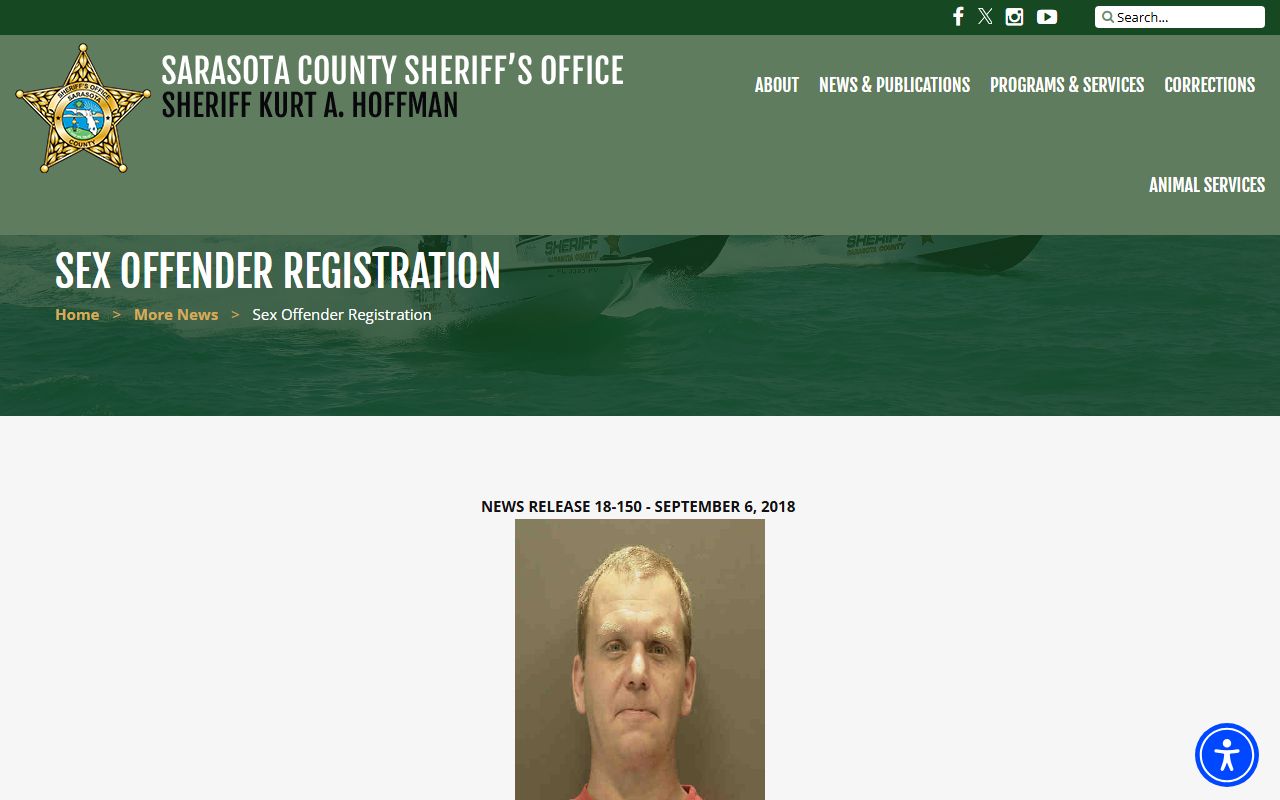
The Sheriff's Office regularly posts registration notifications on its website and social media, giving Sarasota County residents timely information about who is registering a local address.
Florida Registration Laws That Apply in Sarasota County
Sex offender registration in Sarasota County is governed by several Florida statutes. The main one is § 943.0435, which defines who qualifies as a sex offender under Florida law and sets out the full list of registration obligations. That statute requires offenders to report any change in address, employment, vehicle, phone number, or email address within 48 hours of the change. The 48-hour window is not flexible. Missing it constitutes a new criminal offense.
The sexual predator designation is governed by § 775.21, which requires a court to issue a written order before the designation can be applied. Predators face quarterly re-registration requirements, meaning they must appear in person at the Sheriff's Office four times a year. Standard sex offenders re-register twice a year. Both groups must register at the Sheriff's Office rather than by mail, phone, or online portal. These are in-person requirements every time.
Failing to register on time, failing to report an address change, or providing false information during registration are all third-degree felonies under Florida law. A third-degree felony carries up to five years in prison. For predators and repeat offenders, penalties can be higher. The Sarasota County Sheriff's Office takes violations seriously, and compliance checks happen as part of routine enforcement operations.
How to Search Sarasota County Sex Offender Records
The main search tool for Sarasota County sex offenders is the FDLE sex offender search, which covers all 67 Florida counties. You can search by name, county, city, or ZIP code. Filtering by Sarasota County returns all registrants with active addresses in the county. Each result shows the registrant's photo, physical description, registered address, and offense details. Predator profiles are marked with a distinct label. The search tool also lets you search by a geographic radius, which is useful for checking who is registered within a set distance of a specific address.
For a broader search that includes records from other states, the National Sex Offender Public Website (NSOPW) pulls from all participating state registries. If you are trying to find out whether someone moving to Sarasota County from out of state is a registered offender in their previous state, NSOPW is the place to start. Florida's FDLE data feeds into NSOPW, so records from both tools should align for Florida registrants.
The SCSO also encourages residents to sign up for alerts rather than relying only on manual searches. The FDLE alert system sends notifications when a registered offender moves into or near a specified area. Citizens who want ongoing awareness about changes in their neighborhood or near specific locations should sign up through Florida Offender Alert.
Alert Sign-Up for Sarasota County Neighborhoods
Florida Offender Alert is a free notification service tied directly to the FDLE registry. Sarasota County residents can use it to set up automatic email alerts for any area they choose, including their home neighborhood, a school zone, or a park. The system monitors the FDLE registry continuously and sends an alert whenever a registered sex offender or sexual predator registers or updates an address that falls in the monitored area.
The SCSO specifically directs Sarasota County residents to sign up for FDLE notifications as a way to stay informed beyond what the Sheriff's Office posts on its own website and social media. The two systems work together. SCSO posts public notifications for registrations that affect Sarasota County. The FDLE alert system covers all of Florida and catches any change a registrant makes to their address or status, no matter how small. Using both gives residents the most complete picture of who is registered and where.
Sign up at floridaoffenderalert.com. You only need an email address to create an account. Once set up, the alerts run automatically.
Cities in Sarasota County
Sarasota County includes several municipalities. North Port is the county's largest city by population and has its own city boundaries, though sex offender registration is still handled through the Sarasota County Sheriff's Office.
Nearby Counties
Sex offenders leaving Sarasota County must register with the Sheriff's Office of their new county within 48 hours of relocating. The counties adjacent to Sarasota each handle sex offender registration through their respective Sheriff's Offices.