
Miami-Dade County Sex Offender Registry
Miami-Dade County maintains a public sex offender registry through the Florida Department of Law Enforcement, with all in-person registration handled exclusively by the Miami-Dade Police Department's Special Victims Bureau. With over 2.7 million residents, Miami-Dade is Florida's most populous county, and its registry reflects one of the largest concentrations of registered sex offenders and sexual predators in the state.
Miami-Dade Quick Facts
Miami-Dade Sheriff's Special Victims Bureau
The Miami-Dade Police Department runs a dedicated unit called the Special Victims Bureau, Sexual Predator and Offender Unit (SPOU). This office gathers, analyzes, and maintains records on every sex offender and sexual predator living in Miami-Dade County. SPOU does more than keep files. The unit monitors day-to-day activities and addresses to make sure every registrant stays in compliance with Florida Statute § 775.21 and § 943.0435, along with Florida Department of Law Enforcement (FDLE) guidelines. When someone fails to comply, SPOU takes enforcement action.
The unit also processes registrations in accordance with the Adam Walsh Child Protection and Safety Act, a federal law that sets baseline standards for sex offender tracking across all states. Miami-Dade's compliance with Adam Walsh requirements means local records are integrated into the national system, making it possible to search Miami-Dade offenders through the National Sex Offender Public Website.
Miami-Dade's sexual predator and offender information page gives an overview of SPOU services and links to key resources for residents.
The SPOU information page outlines the unit's mission and contact details for Miami-Dade residents who need to report compliance concerns.
Where to Register in Miami-Dade
One thing sets Miami-Dade apart from most Florida counties: registration and re-registration can only happen at one location. No other sheriff district station or municipality can complete any part of the registration process. You must go to the Special Victims Bureau in person. That rule applies to both initial registration and every re-registration appointment after that.
| Office | Miami-Dade Sheriff's SPOU |
|---|---|
| Address | 1701 NW 87th Ave, Suite 222, Miami, FL 33172 |
| Phone | 305-715-3333 |
| Fax | 305-715-3388 |
| SPOU@mdpd.com | |
| Hours | 8:00 a.m. - 4:00 p.m. (closed noon-1:00 p.m.) |
| Closed | Weekends and county holidays |
The Miami-Dade service page for sex offender registration lists current hours and details about the registration process. It is worth checking this page before visiting, since hours can change on county holidays.
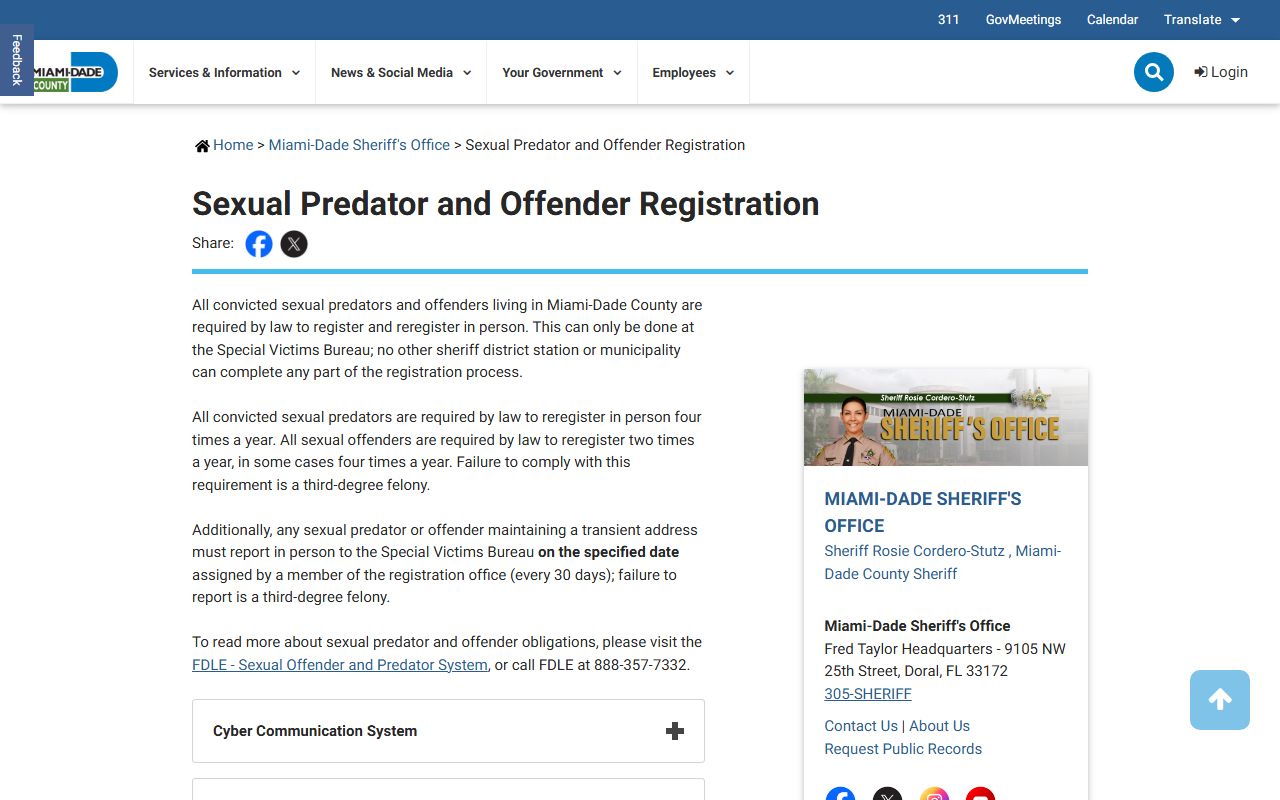
The county's online service page confirms SPOU as the sole registration point in Miami-Dade and provides the most current contact information.
Registration Requirements in Miami-Dade County
Florida law sets the core registration rules for every county, and Miami-Dade enforces them strictly. Under § 943.0435, sex offenders must report any change to their residence, employer, school, vehicle, phone number, or email address within 48 hours. That 48-hour window is firm. It does not matter whether the change is permanent or temporary.
Re-registration frequency depends on your designation. Sexual offenders must re-register in person twice a year. Sexual predators must come in four times a year. Those requirements come directly from state law and apply county-wide. In some cases, offenders are also required to register four times a year. If you are not sure which schedule applies to you, contact SPOU directly at 305-715-3333. Missing a re-registration appointment is not a minor violation. Failure to comply is a third-degree felony under Florida law, which can mean up to five years in prison.
If you are new to Florida and move into Miami-Dade, the 48-hour clock starts the moment you establish residence, not when you find a permanent home. Anyone who works, attends school, or maintains any regular presence in Miami-Dade may also have registration obligations even if they live elsewhere.
Sexual Predator vs. Sexual Offender: What the Labels Mean
Florida law draws a clear line between two designations: sexual predator and sexual offender. The difference matters because it affects how often someone must register, what restrictions apply, and how the public is notified.
Under § 775.21, the sexual predator label is the more serious one. A court must issue a written order to designate someone as a sexual predator. This happens when a person is convicted of a capital or life felony sex offense, or when a person has been convicted of multiple qualifying offenses. Sexual predators must register four times a year and face active community notification requirements. The FDLE sends information about sexual predators to local law enforcement agencies near where the predator lives, and that information is made available to the public.
Sexual offenders, by contrast, are convicted sex crime defendants who do not meet the predator criteria. They still carry significant legal obligations, including bi-annual registration and lifetime registry inclusion in most cases. Both groups are listed in the FDLE statewide database. Both are subject to residency restrictions under § 775.215, which bars registered individuals from living within 1,000 feet of schools, parks, playgrounds, and similar places where children gather.
The distinction also affects what shows up when someone searches the Miami-Dade registry. Predator profiles are often flagged separately and may trigger community alerts. Knowing which category applies helps residents understand the level of ongoing monitoring involved.
Searching the Miami-Dade Sex Offender Registry
The primary search tool for Miami-Dade sex offenders is the FDLE Sex Offender Search. You can look up individuals by name, address, city, county, or ZIP code. The database updates as new registrations and address changes come in, though real-time updates depend on when SPOU processes each case. Searching by county lets you filter results specifically to Miami-Dade.
The FDLE registry shows each offender's photo, name, registered address, physical description, and the offenses they were convicted of. For sexual predators, the entry is labeled clearly. The system also notes whether someone is listed as non-compliant or absconded, which means they have failed to maintain their registration and their current location is unknown.
You can also sign up for email alerts through Florida Offender Alert. This free service sends notifications when a registered sex offender or predator moves into a neighborhood you specify. It covers all of Florida, including Miami-Dade.
The Miami-Dade Sheriff's Office website also links to registry resources and may have county-specific lookup tools depending on what MDPD makes available at any given time.

The sheriff's resource page provides direct links to the FDLE registry and other tools residents can use to search for offenders in Miami-Dade communities.
Transient and Temporary Residents
Some sex offenders and predators do not have a fixed address. They may stay in motels, shelters, or rotate between locations. Florida law accounts for this. Anyone who maintains a transient address in Miami-Dade must report in person to SPOU on a date assigned by the registration office, and that reporting must happen every 30 days without exception. Failing to show up on the assigned date is a third-degree felony.
The transient registration requirement exists because offenders without stable housing present a harder-to-track risk. SPOU assigns specific dates to transient registrants, rather than relying on a calendar-based schedule, to maintain direct contact with this group. If a transient offender's situation changes and they gain a fixed address, they must report the address change within 48 hours under § 943.0435.
Seasonal residents and visitors who spend significant time in Miami-Dade may also have registration obligations depending on the length and nature of their stay. If in doubt, contacting SPOU at 305-715-3333 or emailing SPOU@mdpd.com is the safest way to clarify what the law requires in a specific situation.
Cities in Miami-Dade County
Miami-Dade includes several large incorporated cities, each of which may have local ordinances that add to state-level sex offender requirements. All registered individuals in these cities are still listed in the FDLE statewide database.
Nearby Counties
Sex offenders who move across county lines must re-register in the new county within 48 hours. The counties that border Miami-Dade each have their own registration offices and local enforcement approaches.